
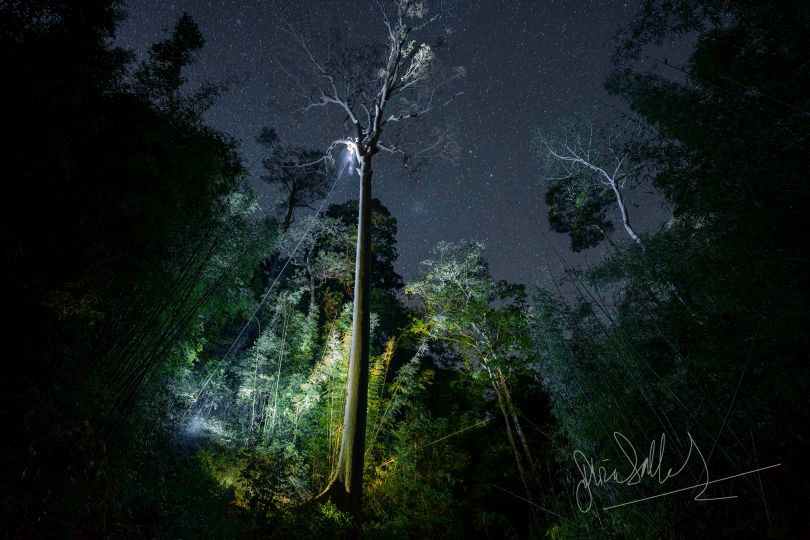
From a distance, the tree looks almost fragile.
A pale, skinny chopstick stuck straight up into the jungle canopy. You’d almost think you could snap it in half if you tried. Then you step right beside its buttress root and realize the rainforest just played a massive optical illusion on you. Up close, the trunk is massive, so wide it takes three people with outstretched arms just to wrap around it.
The air down here is cool, dim, and smells of damp soil, while the top of the tree lives in a world of its own, high up in the bright sunlight.
Cranking your neck to look straight up, your eyes play tricks on you all over again. The highest branches look like delicate little twigs, and the huge, heavy wild bee nests clinging to the wood look no bigger than tiny mushrooms. In reality, those branches have been holding their place up there for generations, carrying the weight of the forest canopy, wild bees and everything else that comes with living twenty stories above the ground.
Standing beneath a living giant that has outlived generations, you suddenly become very aware of your own size. And looking all the way up, a rather practical question comes to my mind:
Why would anyone want to climb this thing?
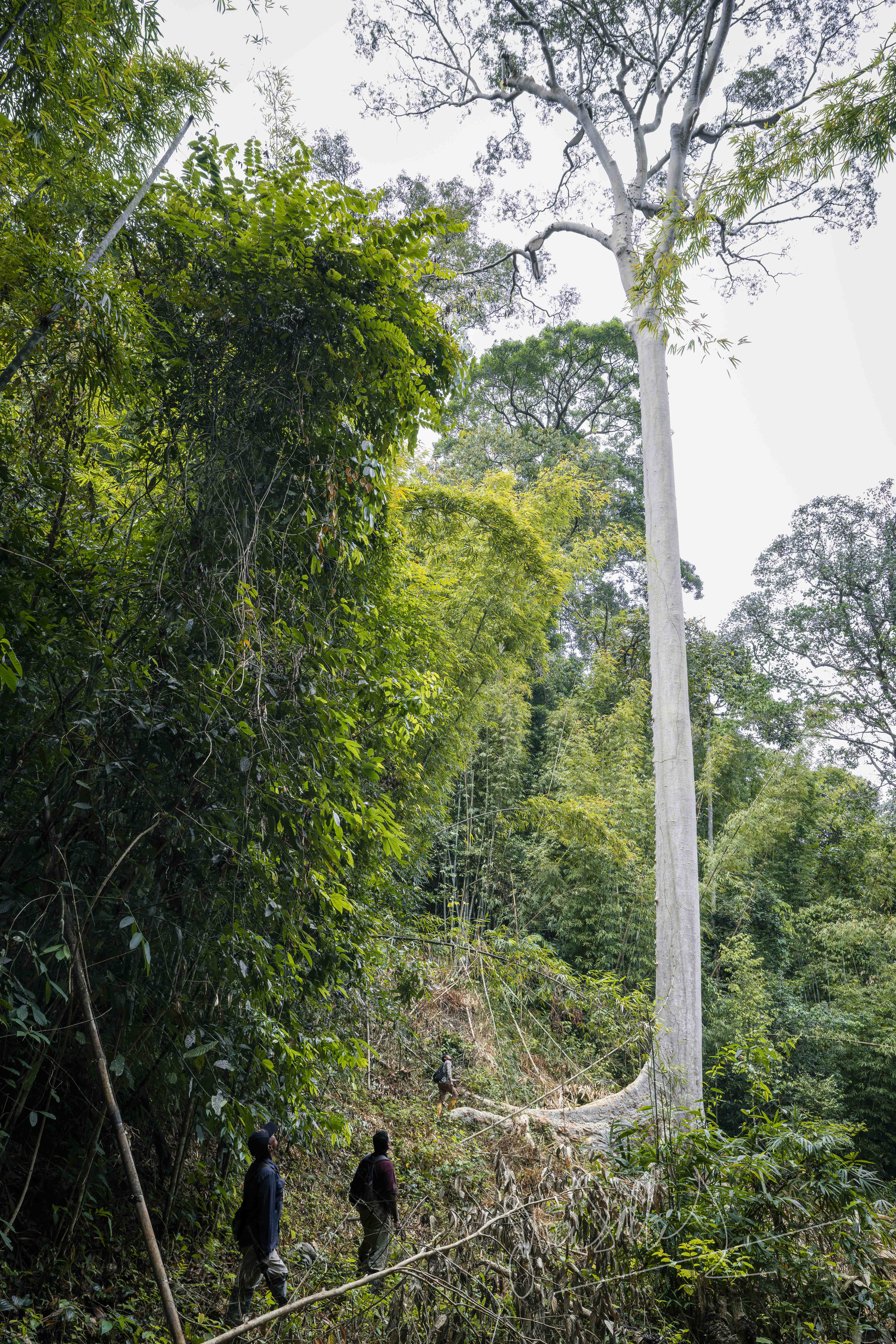
Standing beneath the giant Tualang (Koompassia excelsa) at the Pedu Reserve Forest in Kedah, looking straight up makes your head spin.
The long, smooth trunk shoots straight into the sky until it practically disappears into the clouds. Up there, hidden high in the leafy green canopy, lives an entire hidden colony of the famous giant Asian honeybee, Apis dorsata. From the ground, you can barely see them. The bark is so slick and slippery that it looks like a giant slide, making you wonder how any predator, let alone a human, could ever get up there.
To the wild bees, this tree is the ultimate penthouse.
To anyone else, it looks impossible to climb.
Yet, as I stared up at this ancient giant, completely starstruck, a crazy thought hit me: people actually climb this thing for a living. Not with high tech gear or steel ladders, just sheer guts, patience, and a lot of respect for the height. Looking at a smooth wooden skyscraper that reaches for the clouds, I could only stand there in awe, take a deep breath, and ask myself one simple question.
Would you ever dare to climb it?
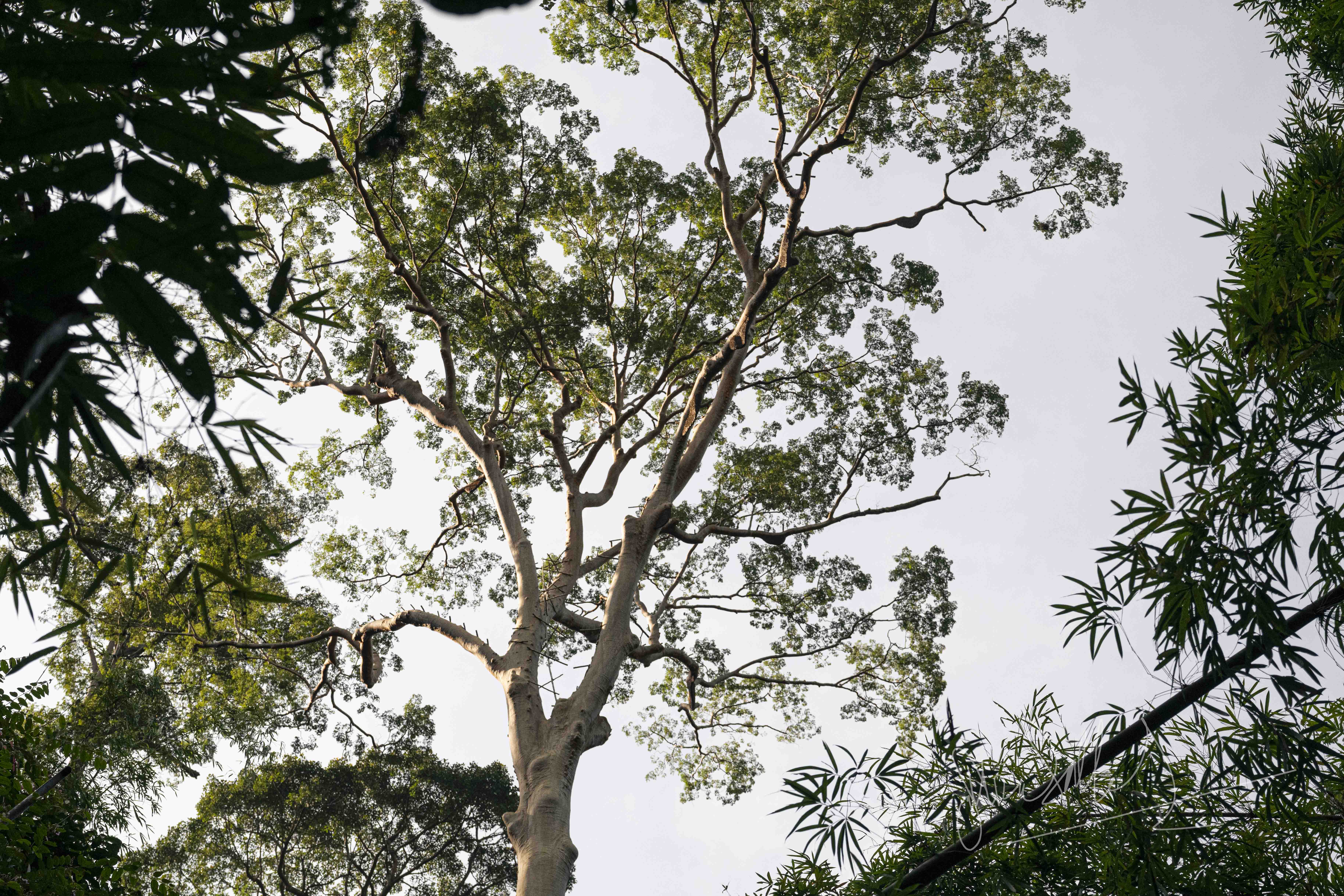
If the local harvesters have been climbing this exact giant for the past 57 years and it was already this tall back then, just how old is it? How long has this quiet giant been standing here in the middle of the jungle, minding its own business?
Thank goodness it lives safely inside a reserve forest, far away from poachers and chainsaws.
And my eyes drifted from the clouds down to the harvesters beside me.
Mind you, I had zero desire to join them. Absolutely not. I was just trying to understand the mind of a person who looks at a slick, twenty story wooden tower surrounded by millions of stinging bees, nods to himself, and says, “Yep, looks like the honey is ready. Let’s go up.”
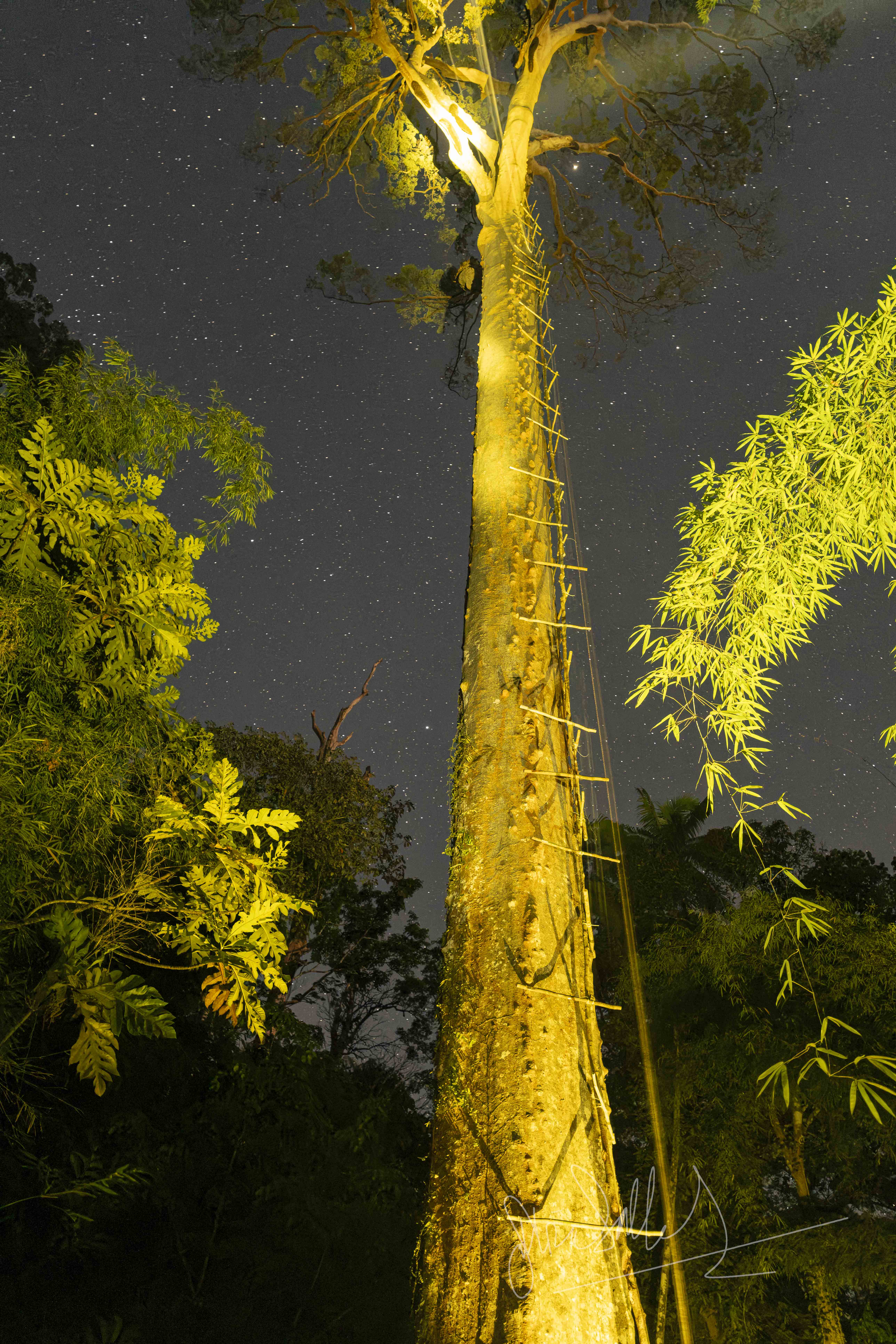
And I should point out that this isn’t just an ordinary Tualang. Out of the many giants scattered throughout the Pedu Reserve Forest, this specific tree has been the favorite hotspot for wild bees to build their colonies every year for more than half a century.
These wild bees are mysteriously loyal and meticulous. Season after season, they return to rebuild in the exact same spots, choosing the absolute highest, thickest branches deep in the canopy to build their home, dangling their massive honeycombs way beyond the reach of anyone standing casually on the ground.
And suddenly, all that terrifying height starts to make a little more sense. The tree isn’t just standing there being ridiculously huge for no reason. It is the center of a much bigger story. A quiet partnership between the giant tree, the wild bees, the rainforest, and eventually, us.
A bottle of Tualang honey might sit quietly on your kitchen shelf looking sweet and harmless, but its origin story begins somewhere considerably less convenient.
That was the exact moment I had to stop looking through my camera viewfinder.
I’ve spent years framing landscapes, mountains, forests, and people through a lens. A camera is wonderful at forcing the world to fit neatly inside a small box. But standing beneath the Tualang, I realized I was far more interested in the part of the scene that no camera could ever capture: the humbling sensation of becoming tiny in front of this giant tree, and the smallest insect that contributed the golden honey.
A photograph can easily show you the tree.
It can show a person standing at its base for scale. What it can’t explain is the sudden shift in your head when you tilt your chin up, trace that endless trunk to the sky, and try to process the sheer distance between your feet and the top.
Sometimes, I think that’s why I prefer to just stand there and look long before taking out my gear. There is always a quiet, necessary moment where you just need to stop, breathe, and figure out what on earth you’re actually looking at.
To be completely honest, I still don’t know what went through the mind of the very first person who looked up at a Tualang tree and decided to climb it.
Perhaps it wasn’t raw courage at all.
Maybe it was pure necessity, deep curiosity, generations of experience, or just a very strong desire to taste the best honey that they can get. Whatever it was, I am endlessly glad someone did. Without that brave first step, we might never have discovered this extraordinary bond between a giant tree, wild bees, and the few people who know how to reach them.
I certainly wouldn’t have discovered the rich, pure Tualang honey that sits on my table today.
As for me?
I am more than happy to keep both feet planted firmly on the ground for now. But every time I stand beneath one of these forest giants, smelling the damp air and looking straight up into the green sky, I can’t help myself. I trace that long, smooth trunk all the way up to the clouds, smile, and ask the exact same thing:
Would you climb this tree?
Cheers
Sally Matsuda

